The Hidden Cost of Cookie Banners: How Europe Lost 5.7 Billion Hours to One Click

Every marketer knows the cookie banner.
Every user hates it.
And everyone clicks the same thing: Accept.
It became a running joke in digital advertising. Yet when you stop and look at the scale of daily web use, it is not a small problem. It is one of the largest collective time taxes ever introduced to the internet.
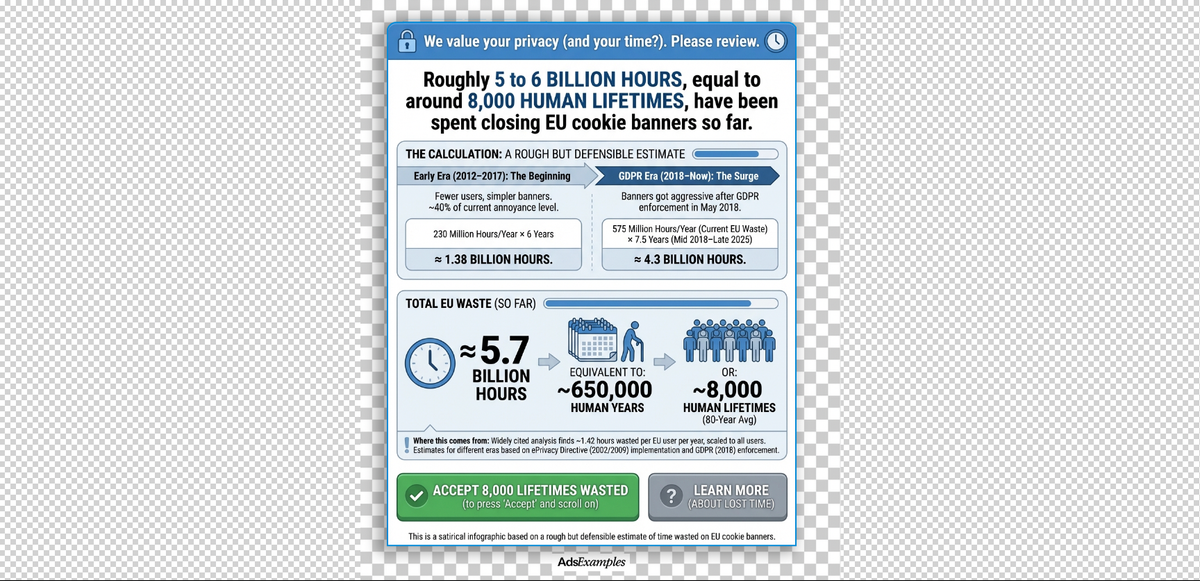
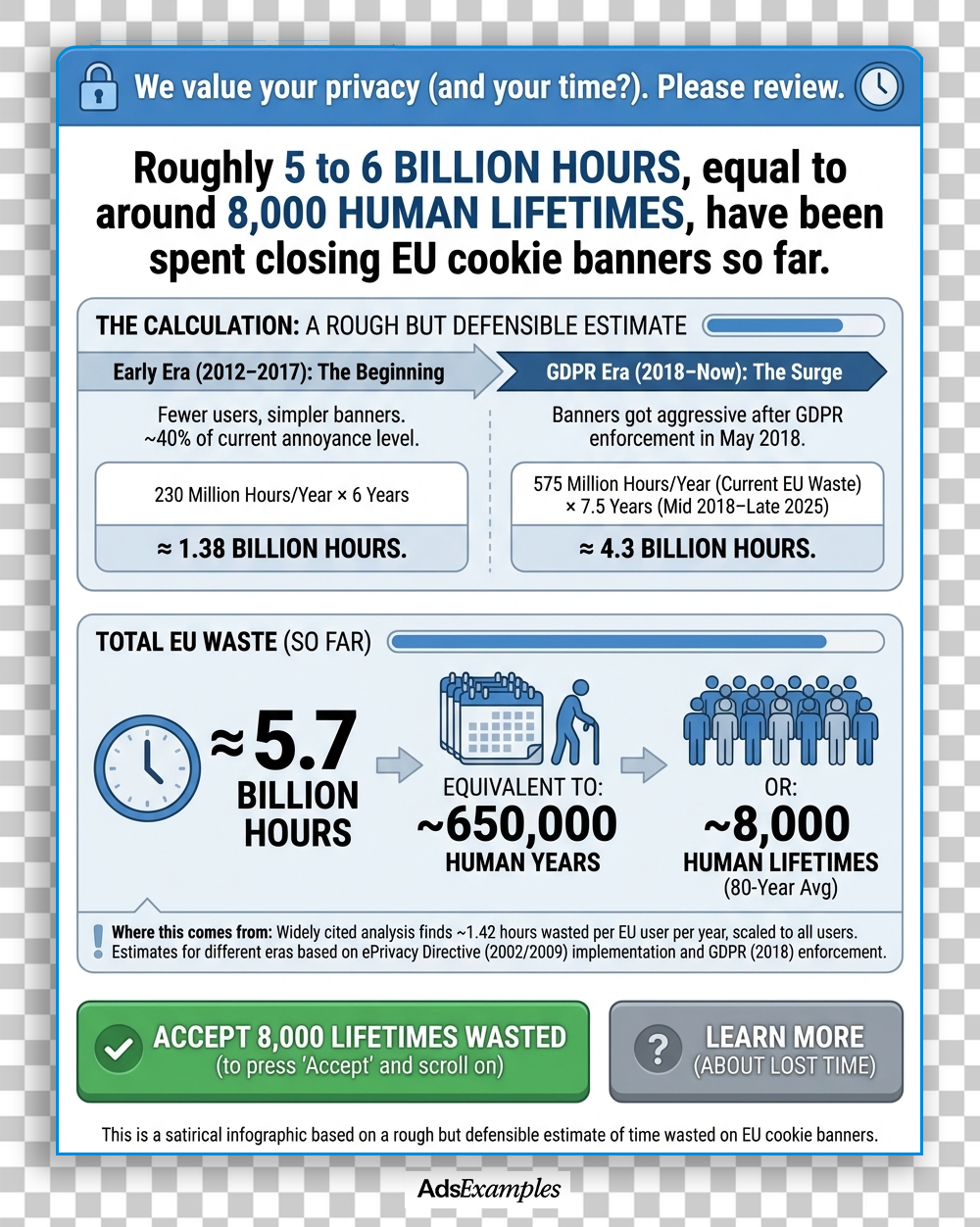
We decided to run the numbers and visualise the result. The infographic below shows a rough but defensible estimate of how much time Europeans have already spent closing cookie banners. The number is shocking.
The Total Waste So Far
Based on user interaction studies, the average EU user loses around 1.42 hours per year to cookie pop ups. Multiply that across Europe and the yearly total is close to 575 million hours. Once GDPR arrived in 2018 the banners became larger, more complex, and more frequent.
If you trace the timeline back to the early years of the ePrivacy Directive, the collective cost becomes enormous.
The current total:
About 5.7 billion hours wasted.
That is around 650,000 human years, which is roughly 8,000 full human lifetimes spent clicking Accept and scrolling on.
This is not satire. This is what happens when small moments of friction scale to an entire continent for more than a decade.
How We Calculated It
Our estimate considers two eras.
The early era (2012 to 2017)
Cookie notices existed but were simpler. Fewer users saw them and fewer sites implemented them. We applied a conservative 40 percent of today’s yearly waste. That still adds up to around 1.38 billion hours.
The GDPR era (2018 to today)
This is when banners truly exploded. Dark patterns grew, consent boxes grew, and interaction time increased. Using the current annual figure of 575 million hours and scaling it across the GDPR era gives another 4.3 billion hours
Together these two periods create a staggering total.
Why This Matters for Marketers
Cookie banners were meant to improve transparency and trust.
Instead, they became the most universal form of ad friction on the internet.
Marketers have watched users:
• Click the fastest possible option
• Automatically ignore the message
• Develop banner blindness that spills over into ad performance
• Get annoyed before ever seeing the page content
It is one of the few UX elements that almost everyone dislikes yet almost every site still deploys.
The irony is that cookie notices do not make most users more informed. They simply make them more frustrated.
A Better Future
With the rise of server side tracking, improved browser privacy features, and simplified consent frameworks, the industry is slowly moving toward a world with fewer pop ups and less friction.
Until then, we are stuck with one of the most expensive one second clicks in history.
Below is the full infographic that breaks down the scale of the problem in detail.