McDonald’s Pulled Its AI Christmas Ad. What It Really Shows About the Future of Media. Watch it here.

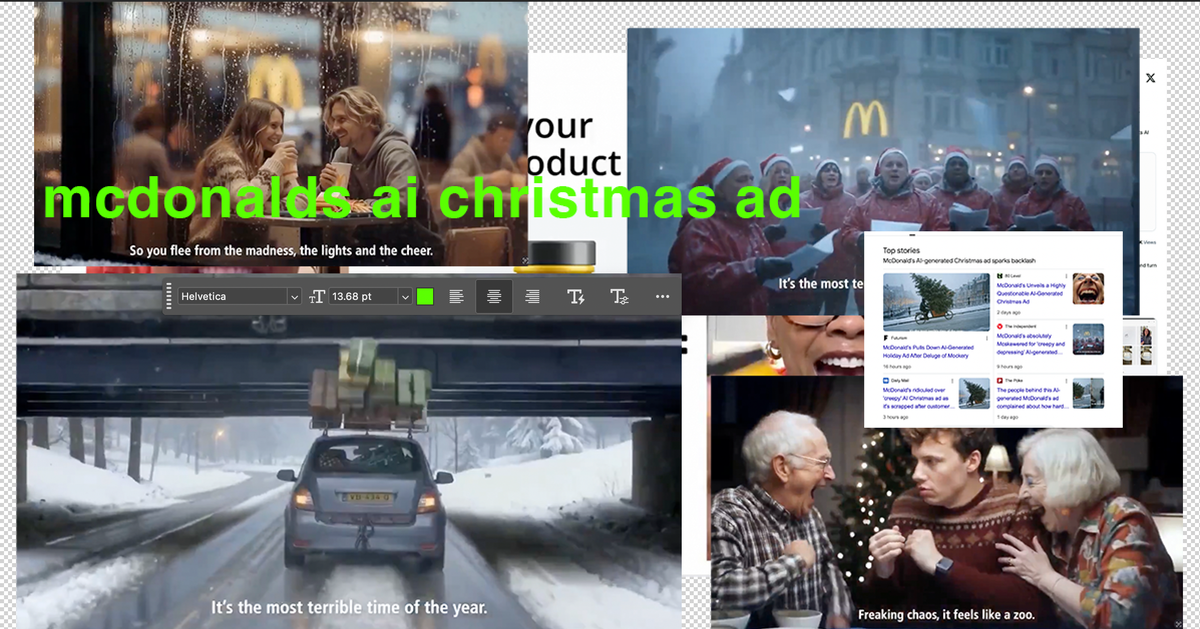
McDonald’s released an AI-generated Christmas advert. It went viral within hours, but not for the reasons the brand expected. The studio behind the project said they hardly slept for several weeks while writing prompts, refining shots, and manually shaping every frame. Their statement was clear. AI did not make the film. Humans did.
And then something even more interesting happened. Comments were disabled on YouTube, the ad was quietly taken down, and the entire campaign turned into a case study that perfectly captures where media is heading.
This moment is bigger than one Christmas advert. It is a preview of the next decade of content creation.
1. AI will not replace human creators. It will replace the production layer.
The studio revealed the truth behind the glossy headline. Creating high quality AI video today still requires human taste, editing, direction, and iteration. The prompts do not write themselves. The scenes do not magically fall into place. What AI does is collapse the cost of production.
Instead of months of planning and filming and animation work, brands can generate near-finished assets in days. The bottleneck shifts from equipment and manpower to imagination and editing.
The McDonald’s advert shows the new ratio of creative work. Less time on cameras and crews. More time on ideas, prompts, refinement, and final human polish.
2. Audiences are not ready for full AI content, but they will be.
The backlash was predictable. People felt the ad was uncanny, slightly unsettling, or simply unnecessary. This is the same reaction photography received when it first threatened painters. It is the same reaction digital art received when it replaced film.
We always resist the thing that lowers the cost of creation. Then we adopt it completely.
Today, people claim they do not want AI video in their adverts. Tomorrow, they will not notice. In a few years, they will expect it.
3. Brands will shift from production heavy campaigns to idea heavy campaigns
Once AI becomes normalised, the value will not come from the video quality. Every brand will have access to the same tools. The advantage will come from the idea itself and the precision of the creative direction.
The McDonald’s team showed how this already works. The script and concept were still human. The feeling of the story was still human. AI simply removed the long, expensive middle part.
This is the future. A world where a creative team with strong taste can produce entire campaigns at the speed of thought.
4. Entire industries will adapt
Advertising will be first. Film, gaming, TV, news, social media, all will follow.
Production agencies that depend on expensive shoots will feel the pressure. New agencies built around AI toolchains will rise faster than old ones can adapt. Influencers will create entire animated worlds on their phones. Small teams will compete with Hollywood level output.
McDonald’s accidentally demonstrated the shift. Not because the ad was perfect. It was not. But because for the first time, a major global brand treated AI video like a normal tool in the production pipeline.
5. The world is moving toward infinite content
AI removes scarcity. The cost of producing one video or one hundred is nearly the same. This means brands will experiment more. They will personalise more. They will test more variations. They will respond to trends instantly.
This is the part people underestimate. The McDonald’s advert is not the final form. It is the awkward early stage before AI video becomes invisible.
We are entering a world where media is generated on demand and tailored to the viewer. Christmas adverts today. Hyper-personalised marketing tomorrow.
Final Thought
The McDonald’s AI advert was not a failure. It was a signal. A moment in time that showed exactly where the industry is heading.
The people who use AI creatively will win. The people who fight it will lose. And the companies that learn to merge human taste with machine speed will dominate the next era of media.
If a global brand is already experimenting with AI-generated Christmas campaigns, imagine what the average creator will produce next year.
This is the future of media. It is messy, controversial, fast, and unstoppable.